

Is Beach Driving Even Legal Where You Are?
The idea of cruising along the shoreline in your own vehicle is incredibly appealing, and it's becoming more popular. But before you even think about hitting the sand, you need to know that beach driving isn't a free-for-all. It's heavily regulated, and in many places, it’s simply not allowed. These regulations exist for very good reasons: protecting fragile coastal ecosystems, ensuring public safety, and managing access to these shared resources.
Permits aren't just a revenue grab; they’re a tool for managing the impact of vehicles on the beach environment. Uncontrolled beach driving can damage dunes, disturb wildlife – particularly nesting sea turtles and shorebirds – and create safety hazards for pedestrians. States and local municipalities are increasingly aware of these issues, and enforcement is getting stricter.
Some states, like California, have significant restrictions on beach driving, with only a handful of locations permitting it, and those often requiring special permits and vehicle types. Other states, like Delaware, generally prohibit driving on ocean beaches altogether. This means a little research is absolutely necessary before planning your trip. Don't assume you can just drive onto any beach you find.
Information changes fast. What was true last year about permits and access might not be true today. Fees increase, regulations shift, and new restrictions are put in place. That’s why this guide is here – to provide you with the most current information available as of 2024, but always double-check with local authorities before you go.

Decoding the Permit Landscape: General Requirements Across States
While each state (and often each county or municipality within a state) has its own specific rules, there are some common threads when it comes to beach driving permits. The most universal requirement is a four-wheel drive vehicle. But this isn't always as simple as it sounds. Some areas specify that all-wheel drive doesn't qualify, requiring true four-wheel drive with a low-range gear.
Beyond that, many jurisdictions demand a current state vehicle inspection. This is to ensure your vehicle is mechanically sound and won't break down and become a hazard on the beach. Expect to provide proof of insurance as well. It's also becoming increasingly common for areas to require a specific tire pressure – often significantly lower than standard road pressure – to improve traction in the sand and minimize damage to the beach surface.
A growing trend is the implementation of mandatory educational requirements. This might involve watching a short safety video (sometimes just 10 minutes long) covering topics like responsible driving techniques, wildlife awareness, and emergency procedures. These courses aren’t meant to be burdensome, but to ensure drivers understand the unique challenges and responsibilities of beach driving.
Finally, and this is critical, your permit must be clearly displayed on your vehicle. Regulations specify exactly where the permit or sticker should be placed, and failing to comply can result in a hefty fine. Don't assume a place that seems convenient is the correct one – check the permit instructions carefully.
- Four-Wheel Drive: Required in almost all locations.
- Vehicle Inspection: Often mandated to ensure mechanical soundness.
- Educational Requirements: Increasingly common, involving safety videos or courses.
- Permit Display: Must be visible and in the designated location.
North Carolina's Outer Banks: A Deep Dive into ORV Permits
North Carolina’s Outer Banks is arguably the most popular destination for beach driving on the East Coast, but it also has one of the most complex permit systems. Each area – Corolla, Nags Head, Emerald Isle, and Currituck County – operates independently with its own rules and fees. Let’s break them down.
Corolla is known for its wild horse population, and beach driving is a major draw for visitors hoping to spot them. Annual ORV permits cost $120 as of 2024, while a 10-day permit will set you back $50. Permits are available online through the Currituck County website: https://www.currituckcountync.gov/departments/beach-recreation/permits/.
Nags Head has the most restrictive regulations. Beach driving is only permitted from October through March, and vehicles must have a valid state inspection and a town permit/sticker. The town website provides details on requirements and application procedures: https://www.nagsheadnc.gov/314/Beach-Driving.
Emerald Isle offers a convenient online permit system. Permits go on sale starting August 1st, with in-person applications at the police department (7500 Emerald Drive) beginning September 1st. The annual permit fee is $100. You can find more information and apply online at https://www.emeraldisle-nc.org/beach-driving-permits.
Currituck County (outside of Corolla) has its own set of beach driving regulations. They emphasize responsible driving practices and wildlife protection. Check their website for specific rules regarding designated access points and speed limits: https://www.currituckcountync.gov/departments/beach-recreation/.
It’s important to note that permit costs have been increasing in recent years, and some permits now expire on December 31st regardless of when they were purchased, effectively shortening the permit duration. Always verify the expiration date and renewal requirements.
Florida's Shores: Navigating Beach Driving in the Sunshine State
Florida presents a bit more of a patchwork when it comes to beach driving regulations. Unlike North Carolina, there isn't a statewide permitting system. Instead, each county (and sometimes individual beaches within a county) sets its own rules. Volusia County, for example, is well-known for allowing beach driving, but requires a permit.
St. Johns County is a good example of a county with specific regulations. Permits are required from March 1st to September 30th, and can be obtained at designated toll booth locations. The cost varies depending on the duration of the permit. Their website provides the most up-to-date information: https://www.sjcfl.net/ParksRec/BeachDriving.aspx.
Other Florida counties where beach driving is permitted (with varying requirements) include Brevard, Flagler, and Walton. It's crucial to check the specific regulations for the beach you plan to visit. County parks and recreation departments are the best source of information.
I'm not sure if there is a central database for all Florida beach driving permits, so extensive research is necessary. It's best to directly contact the county parks and recreation department for the area you are planning to visit to confirm requirements and obtain a permit.
New York's Long Island: Permits, Access Points, and Online Applications
Long Island, New York, offers limited but popular beach driving opportunities, primarily in Suffolk County. 4x4 permits are essential for accessing these areas. You can obtain permits in-person, online, or by phone through Reserve America.
The online application process is convenient, but allow ample time for processing and mailing. Orders placed online or by phone are mailed after approval, which can take several weeks. You can access the Reserve America website at https://www.reserveamerica.com/ or call them directly at 1-800-456-2267 (Monday-Friday 8AM-8PM, weekends 9AM-3PM).
Permits are valid for specific access points, not all beaches on Long Island. Popular locations include Montauk Point State Park and Robert Moses State Park. Check the Suffolk County Parks Department website for a list of designated areas: https://www.suffolkcountyny.gov/Departments/Parks/BeachDriving.
Keep in mind that due to high demand, permits can sell out quickly, especially during peak season. It’s advisable to apply well in advance of your trip. Also, the mailing time for online/phone orders means you need to plan ahead to receive your permit before you travel.
Beyond the Big Three: A State-by-State Snapshot (2024)
While North Carolina, Florida, and New York receive a lot of attention for beach driving, several other states offer opportunities, albeit often with restrictions. Here’s a quick overview as of May 15, 2024. Keep in mind this information can change, so always verify with local authorities.
Texas: Padre Island National Seashore allows beach driving with a permit. Regulations and fees are available on the National Park Service website: https://www.nps.gov/pais/planyourvisit/beach-driving.htm.
Oregon: Some areas of the Oregon Dunes National Recreation Area permit over-sand vehicle use with a permit. Check the Bureau of Land Management (BLM) website for details: https://www.blm.gov/visit/oregon-dunes-national-recreation-area.
Washington: Coastal areas managed by the Washington State Parks and Recreation Commission may allow beach driving with a permit. See their website for more information: https://parks.wa.gov/.
California: Beach driving is highly restricted in California. However, certain areas, like the Imperial Beach Dunes, allow it with a permit. Check the local city or county website for regulations.
New Jersey: Limited beach access is available in certain areas, often requiring permits and seasonal restrictions. Contact the local municipality for details.
- Texas: Padre Island National Seashore - Permit required.
- Oregon: Oregon Dunes National Recreation Area - BLM permit needed.
- Washington: State Parks - Check local regulations.
- California: Highly restricted, limited access with permits.
- New Jersey: Limited access, contact local municipalities.
Beach Driving Permits 2024: Complete State-by-State Guide to Fees, Requirements, and Where to Get Them
| State | Permit Required (Yes/No) | General Cost Range | Key Website Link |
|---|---|---|---|
| North Carolina | Yes | $50 - $120 (annual) | https://www.ncparks.gov/beach-access/permits |
| Florida | Yes (varies by county) | $30 - $80 (annual/daily) | https://floridadep.gov/rcd/beach-accessibility |
| New Jersey | Yes (seasonal) | $20 - $150 (daily/seasonal) | https://www.nj.gov/dep/parksandforests/parks/beachdriving/ |
| Texas | Yes (Galveston Island State Park) | $10 (daily park entrance) + potential beach driving permit | https://tpwd.texas.gov/state-parks/galveston-island |
| Oregon | Yes (certain areas) | $5 - $30 (daily/annual) | https://oregonstateparks.org/index.php/parks/beach-driving |
| Washington | Yes (Pacific Beach) | $30 (annual) | https://www.graysharbor.washington.gov/444/Beach-Driving-Permits |
Data sourced from AI research — verify before making decisions
The Application Process: Online, In-Person, and By Phone
The method for applying for a beach driving permit varies depending on the location, but generally falls into one of three categories: online, in-person, or by phone. Understanding the process for each can save you time and frustration.
Online applications are becoming increasingly common. You’ll typically need to create an account, provide vehicle information, upload proof of insurance and registration, and pay the permit fee. Processing times can vary, so apply well in advance. Be prepared to provide a digital copy of your driver’s license as well.
In-person applications usually involve visiting a police department, toll booth, or designated permit office. Bring all required documentation with you, including your driver’s license, vehicle registration, proof of insurance, and any applicable inspection reports. Be prepared to pay the permit fee on the spot.
Phone applications are often handled through a third-party vendor like Reserve America. Have all your information readily available when you call, including your vehicle details, insurance information, and payment method. The Reserve America contact number is 1-800-456-2267, and they are available Monday-Friday 8AM-8PM, and weekends 9AM-3PM.
Regardless of the method you choose, it’s crucial to have all required documentation ready before you begin the application process. This will streamline the process and minimize delays.
Avoiding Fines and Staying Safe: Essential Beach Driving Etiquette
Obtaining a permit is only the first step. Responsible beach driving requires adherence to a set of rules and a commitment to protecting the environment. Speed limits are typically lower on beaches than on paved roads – often 25 mph or less – and strictly enforced. Stick to designated driving areas and avoid driving on dunes or in vegetated areas.
Wildlife protection is paramount. Be particularly mindful of nesting sea turtles and shorebirds. Avoid disturbing nesting sites and keep a safe distance from wildlife. Leave no trace behind – pack out all trash and avoid leaving tire tracks. Always yield to pedestrians.
Recovery gear is essential. A tow strap, shovel, and tire pressure gauge are minimum requirements. Knowing how to use them is equally important. If you get stuck, don’t spin your tires – it will only dig you in deeper. Call for assistance if needed.
Violations of beach driving regulations can result in substantial fines. More importantly, irresponsible driving can cause significant environmental damage. A little common sense and respect for the environment can go a long way in ensuring a safe and enjoyable experience for everyone.
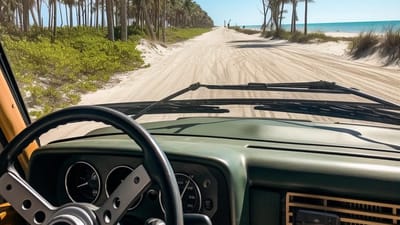
Beach Driving 101: Air Down, Get Traction & Avoid Getting Stuck!
CoastBuddy Off-Road
Watch on YouTube →
No comments yet. Be the first to share your thoughts!